
Introduction - Why Does Mauritania Require IPv6?
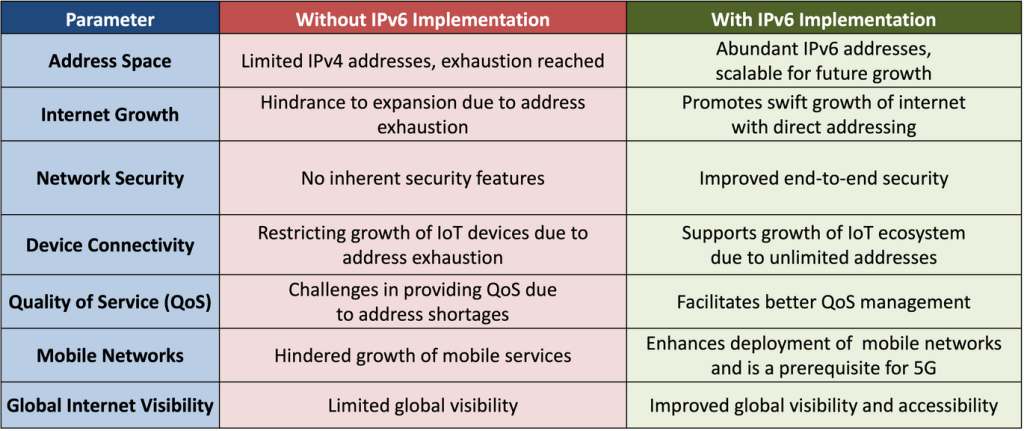
IPv6 brings a massive increase in available internet addresses and better network performance, which is crucial for supporting new technologies and online services. Mauritania needs to adopt IPv6 to remain competitive and connected on the global stage in our increasingly digital world.
Latest News and Committee Updates
Mauritania: 2,300 km of Fiber Optic Cable to Boost the Digital Sector
Digital transformation is in full swing across the continent. Building...

Guide to the Digital Ecosystem
To develop a dynamic directory of digital businesses, the Ministry...

The Minister of Digital Transformation Calls for Accelerated Implementation of Digital Projects
The Minister of Digital Transformation and Administrative Modernization, Mr. Ahmed...

Nouakchott Mobility Project 2026: The Ministry at the Heart of Operational Efficiency
The Minister of Digital Transformation and Administrative Modernization, Mr. Ahmed...

Message from the Minister
In today’s rapidly evolving digital landscape, the Ministry of Numeric Transformation and Administration Modernization recognizes the critical role that IPv6 plays in Mauritania’s future. IPv6, the next-generation Internet Protocol, offers a vastly expanded address space and improved network performance, paving the way for seamless integration of new technologies and services.
Adopting IPv6 is not simply a technical upgrade; it is a strategic imperative that will enable Mauritania to stay competitive and connected in an increasingly digital world. With IPv6, we can:
- Expand Connectivity: Ensure that every citizen and business has access to the internet, regardless of location or device.
- Embrace Innovation: Support the growth of emerging technologies such as the Internet of Things (IoT), 5G, and smart cities.
- Enhance Security: Strengthen our digital infrastructure and protect against cyber threats.
- Foster Economic Growth: Create new opportunities for businesses and attract foreign investment.
The Ministry is committed to leading Mauritania’s transition to IPv6, working in collaboration with stakeholders across the public and private sectors. We encourage all citizens and organizations to join us in this journey towards a more connected and prosperous future.
Together, let’s build a digital Mauritania empowered by IPv6.
Ahmed Salem BEDDE
Minister of Digital Transformation and Modernization of the Administration
Ahmed Salem Bedde,
Minister of Digital Transformation
and Modernization for the Administration
Strategy & Vision
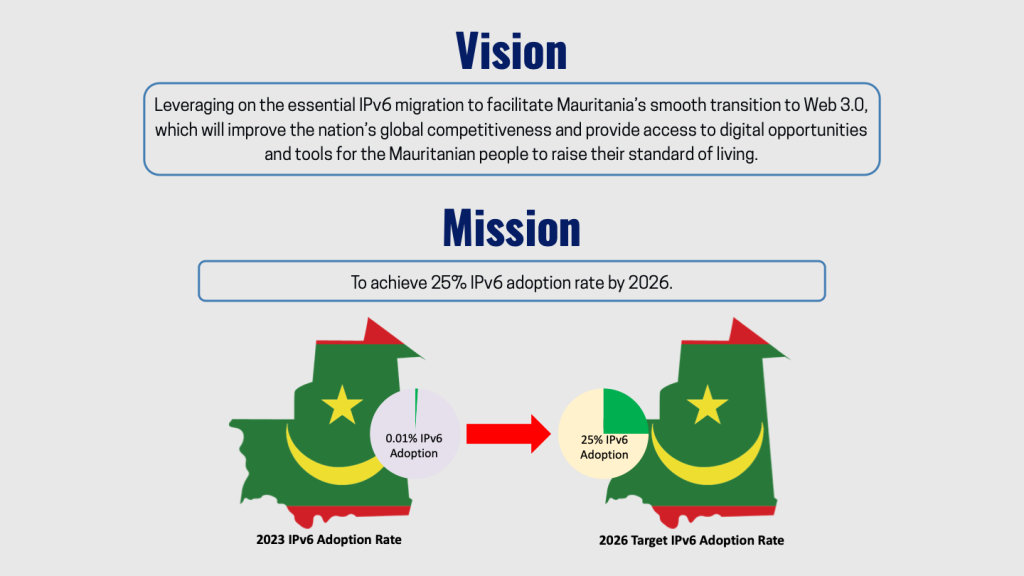
The strategic national plan for IPv6 transition in Mauritania outlines a critical and structured approach to adopting IPv6 in response to the inevitable depletion of IPv4 addresses. This transition is essential for Mauritania to maintain its competitiveness and connectivity in an increasingly digitized global environment. The introduction highlights the significant benefits of IPv6, which include expanded address space and enhanced network performance, crucial for fostering the rapid development of new technologies and services in Mauritania.
The plan details a comprehensive assessment of the current readiness for IPv6 adoption across various stakeholders, including governmental agencies, Internet service providers, and private enterprises. This assessment is crucial to understand the collaborative efforts required for a smooth transition. The strategy also emphasizes the transformational potential of IPv6 for the Mauritanian digital landscape, intending to enhance economic growth, innovation, and national security through improved online services and infrastructure.
Events
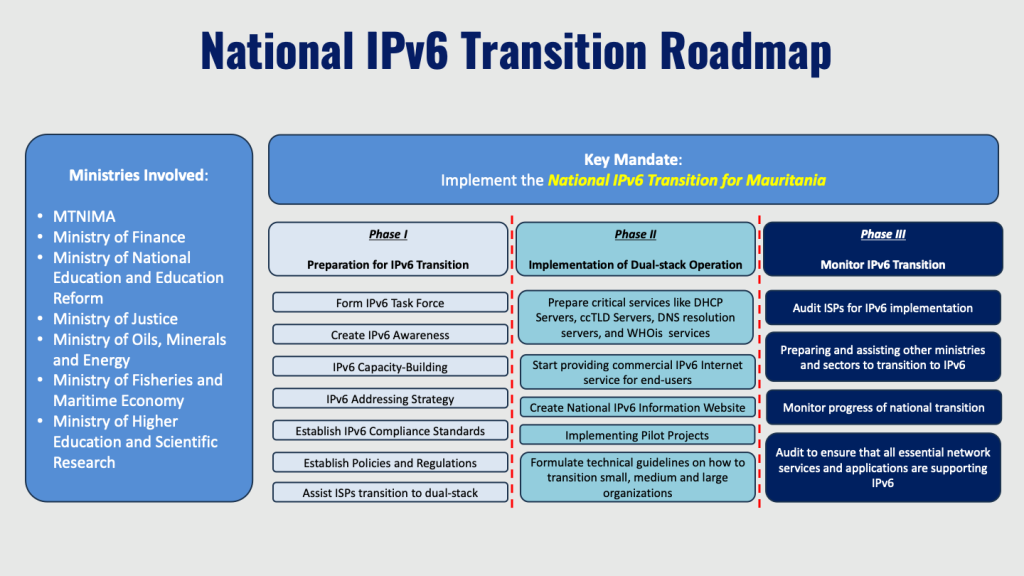
National IPv6 Committee
The National IPv6 Committee plays a crucial role in orchestrating the nationwide transition to IPv6, under the strategic guidance of the Ministry of Digital Transformation. This committee, pivotal in driving the shift towards a more robust and scalable internet infrastructure, includes a diverse panel of experts from various sectors, including key local operators. They collectively work to ensure a seamless and effective adoption of IPv6 across Mauritania, addressing technical, strategic, and policy-related challenges. This initiative not only supports the nation's digital transformation agenda but also enhances connectivity standards to meet future technological demands.
Contact Us
Lorem ipsum dolor sit amet, consectetur adipiscing elit. Ut elit tellus, luctus nec ullamcorper mattis, pulvinar dapibus leo.
FAQs
1. What is IPv6? IPv6 (Internet Protocol version 6) is the most recent version of the Internet Protocol (IP), the communications protocol that provides an identification and location system for computers on networks and routes traffic across the Internet.
2. Why is IPv6 important? IPv6 is important because it provides a much larger address space than IPv4, the previous version of IP. This is critical because the number of devices connecting to the internet is increasing rapidly, and IPv4 is running out of addresses. IPv6 also offers improved network performance and security.
3. What are the main benefits of IPv6? The main benefits of IPv6 include:
- Larger address space: IPv6 provides a vastly larger address space than IPv4, ensuring that there are enough addresses for all devices that need to connect to the internet.
- Improved network performance: IPv6 includes features that can improve network performance, such as simplified packet headers and better support for multicast.
- Enhanced security: IPv6 includes built-in support for IPsec, a security protocol that can encrypt and authenticate traffic.
- Auto-configuration: IPv6 devices can automatically configure themselves, making it easier to set up and manage networks.
4. How is an IPv6 address different from an IPv4 address? An IPv6 address is 128 bits long and is represented by eight groups of four hexadecimal digits, separated by colons. An IPv4 address is 32 bits long and is represented by four decimal numbers, separated by periods.
5. How can I check if my device supports IPv6? You can check if your device supports IPv6 by running a simple command in your operating system’s command prompt or terminal. The exact command will vary depending on your operating system.
6. How do I transition to IPv6? The transition to IPv6 is a gradual process. Many internet service providers (ISPs) and network equipment manufacturers are already supporting IPv6. You can check with your ISP to see if they offer IPv6 connectivity. If they do, you may need to upgrade your router or other network equipment to support IPv6.
7. Is IPv6 backward compatible with IPv4? IPv6 is not directly backward compatible with IPv4. However, there are transition mechanisms that allow IPv6 and IPv4 devices to communicate with each other.
8. Is IPv6 more secure than IPv4? IPv6 includes built-in support for IPsec, which can provide enhanced security. However, IPv6 is not inherently more secure than IPv4. It is important to use proper security practices, regardless of which version of IP you are using.